
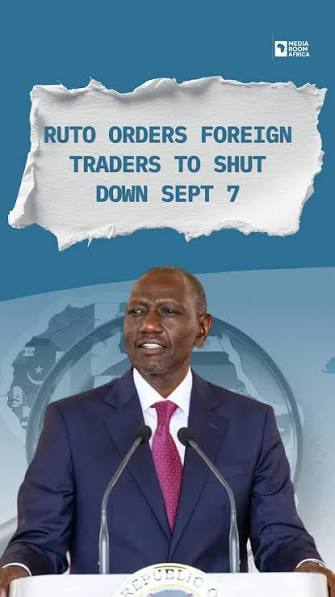
Title: The Scapegoat Syndrome: Why Ruto’s Ultimatum to Foreign Traders Threatens Kenya’s Soul
In a move that has sent shockwaves through the bustling markets of Nairobi, Kisumu, and Mombasa, President William Ruto has issued a hardline ultimatum aimed at small-scale foreign traders, demanding they cease their operations in Kenya. While the government frames this as a protective measure for local businesses, a closer examination reveals a policy steeped in short-term political gain rather than long-term economic sense. This directive is not merely an administrative overreach; it is a dangerous gamble with the country’s social harmony. By drawing a line in the sand based on nationality rather than business practices, the administration is fanning the flames of xenophobia, creating a hostile “us versus them” narrative that threatens to unravel the fragile tapestry of peace that Kenya has enjoyed for decades.
The rhetoric emerging from State House dangerously echoes the dark chapters of xenophobic violence witnessed in South Africa, where marginalized foreign nationals became punching bags for systemic economic failures. By publicly singling out traders from neighboring countries—many of whom are refugees or economic migrants fleeing hardship—the government is giving implicit permission for vigilante justice and mob violence. History has taught us that when leaders dehumanize a community through public ultimatums, it empowers rogue elements in society to take the law into their own hands. We have already seen cases of looting and forced evictions of foreign shop owners in various counties, and without immediate rectification, this crackdown could spiral into widespread inter-community violence. Kenya’s stability is its greatest asset; jeopardizing it to score cheap political points against a marginalized minority is not just irresponsible—it is reckless.
Furthermore, this ultimatum stinks of hypocrisy and a profound misunderstanding of Kenya’s regional position. Kenya has long prided itself as the economic gateway to East Africa, a hub of commerce that welcomes investment and labor from Uganda, Tanzania, Rwanda, and beyond. This open-door ethos is enshrined in the East African Community (EAC) protocols, which guarantee the right of establishment and free movement of goods and persons. By unilaterally disregarding these treaties, President Ruto is not only alienating our closest neighbors but also signaling to the global community that Kenya is closing its doors. The informal sector, where these foreign traders operate, is the lifeblood of our urban economies. These traders are not “stealing” wealth; they are filling market gaps, working hours that many locals shun, and often sourcing their stock from local Kenyan wholesalers. To treat them as parasites is to ignore the symbiotic, albeit complex, relationship they have with the local supply chain.
Perhaps the most infuriating aspect of this directive is its utter futility in addressing the root cause of Kenya’s unemployment crisis. The government is attempting to convince an angry, jobless youth population that their salvation lies in evicting a few dozen foreign vegetable sellers and second-hand clothes vendors. This is a cruel and dangerous illusion. The reality is that the unemployment rate in Kenya is a structural problem borne out of deindustrialization, a mismatch between education and market needs, and a severe lack of access to affordable credit for local startups. A foreign trader operating on a shoe-string budget occupies the bottom rung of the economic ladder—a rung that is already overcrowded with desperate locals who lack the capital to move up. Removing these foreigners will not create a single sustainable job for a Kenyan graduate; it will merely redistribute the poverty to someone else.
If the government were genuinely interested in helping the common unemployed Kenyan, it would shift its focus from performative xenophobia to substantive policy reform. Why not tackle the exorbitant cost of business permits and licenses that choke local entrepreneurs? Why not invest in the woefully inadequate power supply and transportation networks that increase the cost of doing business? Why not create special economic zones in rural areas to stem the tide of urban migration? These are the difficult, unglamorous tasks of governance that require time, capital, and political will. Instead, the administration has chosen the path of least resistance: blaming the “outsider.” This is a distraction tactic designed to divert attention from the government’s own shortcomings in delivering on its campaign promises of economic turnaround.
Ultimately, this ultimatum is a stain on Kenya’s reputation as a tolerant, progressive nation. It breeds resentment among our neighbors, endangers the lives of innocent people, and offers a false panacea to our unemployed youth. The peace and tranquility of this nation were built on the principle of *Harambee*—pulling together regardless of tribe or origin. We cannot allow populist grandstanding to dismantle that heritage. True prosperity will come from innovation, infrastructure, and education—not from kicking down the kiosks of our foreign brothers and sisters. Let us call this policy what it truly is: a xenophobic scapegoat that solves nothing and endangers everything. The President must rescind this ultimatum and instead focus on the hard work of building a Kenya that works for all who live within its borders, regardless of where they were born.